
Active classroom: an innovative teaching method at the Lycée français international d’Alicante
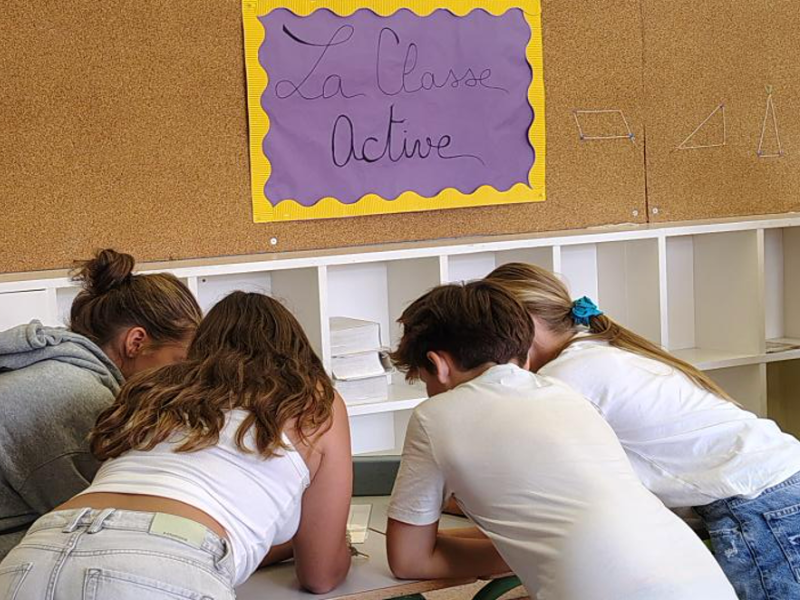
Pupils standing around a table island, whiteboards full of hypotheses, a microphone passed from hand to hand. That is what the Active Classroom looks like in some lessons.
It is one of the active teaching methods used at the Lycée français international d’Alicante (LFIA). It does not replace other ways of teaching and is not used in every lesson. It is one more tool that some teachers bring into certain lessons when it suits what their pupils need to learn.
In this article we explain what the method involves, what a lesson looks like, how it has been rated and how families can support it. And so you can see it in action, we have included a video filmed in one of our classrooms.
What is the Active Classroom?
The Active Classroom is a method based on active learning. During the lesson, pupils take a direct part in their own learning: they experiment, cooperate with their classmates and build their own reasoning.
At LFIA it sits alongside other methods within the school’s educational project. It is used by 13 teachers in Alicante and Murcia in some of their lessons, across different year groups and subjects: French, Maths, Science, Economics and Social Sciences, History-Geography and Latin. Each teacher decides when to use it according to the objectives of each sequence.
Why choose active teaching methods?
The teachers’ aim was for learning to stick, rather than depend only on the next test. The Active Classroom is designed to build lasting skills. Its objectives:
- To put pupils at the centre of their own learning.
- To give meaning to schoolwork and boost motivation.
- To develop independence and organisation.
- To learn to cooperate, in pairs and in groups.
- To build working methods that are useful in every subject.
- To strengthen the link with families in following pupils’ independent work.
How does an Active Classroom lesson work?
When a teacher uses it, pupils work in table islands, often standing. They write on whiteboards and on the windows, and the classroom has a reading corner, a help corner and a lectern with a microphone for speaking activities.
Each lesson is organised in 3 stages:
- The hook. A video, an image or a real situation sparks curiosity and brings out what pupils think they already know.
- The action. Pupils investigate together. Who speaks is decided by drawing lots, so nobody is left out.
- The wrap-up. A whole-class review fixes the key points and each pupil finishes with an individual task.
Examples at different stages
Some examples of how teachers on the team use it:
- Early Years: “float or sink” workshops and sound games.
- Primary: weekly maths puzzles in a CM2 class.
- Collège and Lycée: grammar discovered through observation, open-ended problems in Maths and debates in Economics and Social Sciences, such as free trade versus protectionism.
READ THE ACTIVE CLASSROOM NEWSLETTER
Watch it on video
Nothing explains it better than seeing it. Step into one of our classrooms and discover what a lesson looks like from the inside:
▶ Watch the video of an Active Classroom lesson at the Lycée français d’Alicante
Benefits of the Active Classroom
- Pupils are active: they take part, experiment and build their own learning.
- They learn with others: mutual help, cooperation and solidarity.
- They speak up: they become more confident at listening, arguing and debating.
- They become more independent: they learn to organise themselves and track their progress.
- A mix of teaching styles: explicit, flipped, cooperative or project-based.
- A spiral progression: one that boosts motivation and a close relationship between teacher and pupil.
- And also: it strengthens the link with families and helps consolidate learning.
Results: how participating pupils rated it
At the end of 2025-2026, the 30 pupils in 5e (1.º ESO) who took part in the pilot project completed an anonymous questionnaire to evaluate it. This is a small sample reflecting the views of this particular group. It is not representative of all LFIA pupils.
| Indicator | Participating pupils answering “yes” |
|---|---|
| Felt more involved | 80% |
| Understand better | 80% |
| Feel more independent and cooperative | 80% |
| Recommend the Active Classroom | 93% (83% without any reservation) |
What is more, almost all the pupils in this group now apply these methods in Maths.
What teachers observe
“The number of spoken contributions in an hour multiplies.” — Émilie Borredon, French
“A genuinely studious classroom dynamic.” — Landry Ivanez, Maths
“Always motivated, each according to their abilities.” — Isabelle Jassigneux, CM2
The team is also clear about what needs to improve this year: setting aside more time for written summaries, which are essential before exams, and giving clearer guidance to pupils who find the change harder.
A method gaining ground at LFIA
- 2024-2025: a pilot team of teachers is formed and the first trials take place.
- 2025-2026: six pioneering teachers bring it into some of their lessons.
- 2026-2027: 13 teachers in Alicante and Murcia use it in lessons across different year groups, with ongoing training, open lessons between colleagues and monthly meetings to share experience.
How can families help?
Without support at home, the Active Classroom only goes halfway. Three simple habits make all the difference:
- Ask your child to explain, not just recite: “What did you learn today? Explain it to me.”
- Show as much interest in the method as in the mark: “How did you do it?”
- Help them set up a routine for independent work.
Frequently asked questions about the Active Classroom
Is the Active Classroom used in every LFIA lesson?
No. It is one method among others in the school’s educational project. It is used by 13 teachers in some of their lessons, across different year groups and subjects, alongside other ways of teaching.
Does active teaching prepare pupils well for exams?
Yes. Each lesson ends with a whole-class review and an individual task, and this year the team is strengthening written summaries to consolidate learning.
What do pupils think?
The 30 pupils in 5e who took part in the project in 2025-2026 evaluated it at the end of the year. 93% recommend the Active Classroom and 80% say they understand better. These figures reflect only that group’s opinion and are not representative of all pupils at the school.
Discover the Lycée français international d’Alicante
The Active Classroom is one of the methods through which LFIA, a member of the Mission laïque française network, combines academic excellence, multilingualism and personal development. To find out more about our educational approach, visit our website and follow us on Instagram to see everyday life in our classrooms.
Book a visit to the school or an interview with our admissions team.